


Every year, corrosion costs the global economy an estimated 3–4% of GDP—and a significant portion of that loss traces back to improperly selected fasteners. For industrial procurement officers, design engineers, and maintenance professionals, the question is rarely “which fastener is cheapest?” but rather “which fastener will survive this environment?” The global industrial fasteners market, valued at approximately USD 88–93 billion in 2025, continues to grow as industries push into more demanding environments—offshore wind, chemical processing, marine infrastructure, and high-temperature automotive applications. Yet despite the availability of advanced materials, stainless steel fasteners and carbon steel fasteners are still routinely misapplied, leading to premature failure, safety risks, and costly downtime.
This guide examines the engineering trade-offs between 316 stainless steel and carbon steel fasteners in corrosive environments, with practical selection criteria drawn from ASTM standards and field performance data.
1. Understanding the Corrosion Challenge: Why Material Matters
Corrosion in fasteners is not a single phenomenon—it manifests as uniform surface attack, pitting, crevice corrosion, galvanic corrosion, and stress corrosion cracking (SCC), each requiring different material responses. The severity depends on three factors: the fastener material’s passive film stability, the presence of chlorides or other aggressors, and the galvanic relationship with adjacent metals.
Carbon steel fasteners—including common grades such as Grade 5, Grade 8, and metric classes 8.8, 10.9, and 12.9—derive their strength from their iron-carbon composition. However, this same composition makes them vulnerable to oxidation. Protective coatings such as zinc plating, hot-dip galvanizing, or black oxide can delay corrosion, but these coatings are sacrificial and have finite service lives. Once breached, the underlying steel corrodes rapidly, particularly in marine or humid environments.
Stainless steel fasteners, by contrast, rely on a chromium-rich passive oxide layer for corrosion resistance. The 300-series austenitic grades—particularly 304 and 316—offer significant corrosion resistance when compared to standard carbon steel materials. However, not all stainless steels are equal: 316 contains molybdenum (typically 2–3%), which dramatically improves resistance to pitting and crevice corrosion caused by chloride exposure.
Common misconception: Stainless steel is “rust-proof.” In reality, stainless steel fasteners are “rust-resistant” under specific conditions—and can fail spectacularly in high-chloride, high-temperature, or oxygen-deprived environments.
2. 316 Stainless Steel vs. Carbon Steel: A Side-by-Side Comparison
2.1 Composition and Corrosion Mechanisms
Property | 316 Stainless Steel | Carbon Steel (Grade 8 / Class 10.9) |
|---|---|---|
Typical composition | 16–18% Cr, 10–14% Ni, 2–3% Mo | Iron + 0.3–0.6% C (alloyed for strength) |
Corrosion protection mechanism | Passive chromium oxide film (self-healing) | Sacrificial coating (zinc, galvanized, or organic) |
Resistance to chlorides (marine) | Excellent (recommended for coastal and submerged use) | Poor—coating failure leads to rapid rusting |
Resistance to general atmospheric corrosion | Excellent | Moderate to good (coating-dependent) |
Galvanic corrosion risk | Lower (noble) when paired with compatible metals | Higher (anodic)—accelerates when paired with stainless or copper |
Typical service life in marine splash zone | 10–25+ years (grade-dependent) | 1–5 years (coating-dependent) |
The increased nickel content in 316 SS contributes to its improved corrosion resistance compared to 304, while molybdenum provides added strength and pitting resistance. 316 is therefore recommended for use in coastal regions with increased salt content, or in areas with higher levels of pollution or corrosive chemicals—particularly chlorides.
2.2 Strength Considerations
While high tensile fasteners are often associated with carbon steel—and for good reason—the strength comparison is more nuanced than a simple “stainless is weaker” generalization. Stainless steel fasteners available on the market are generally equal to or higher in tensile strength than commercially used carbon and low-alloy steel fasteners.
For carbon steel, strength is graded by property class. Class 8.8 bolts have a minimum tensile strength of approximately 800 MPa and are suitable for general mechanical structures. Class 10.9 bolts exceed 1,000 MPa and are commonly found in automotive chassis and engineering machinery. Class 12.9 bolts represent the ultra-high-strength tier at 1,200+ MPa, used in wind power, rail transit, and high-end equipment manufacturing. Grade 8 bolts (SAE) have a proof strength of approximately 840 MPa.
For 316 stainless steel, tensile strength typically ranges from 515–620 MPa (annealed condition), with work-hardened versions reaching higher values. While this is lower than the highest-grade carbon steels, 316 offers a critical advantage: its strength is retained throughout its service life because corrosion does not progressively reduce the effective cross-section. A carbon steel fastener that loses 20% of its diameter to corrosion has effectively lost 36% of its tensile capacity—a degradation that does not occur with properly specified stainless steel fasteners.
2.3 Cost-Benefit Analysis
Carbon steel fasteners are generally lower cost than stainless steel, and finishes are available that provide excellent corrosion resistance. However, these finishes contribute to dimensional growth that must be considered in design. 316 stainless steel fasteners cost more than 304, and both cost more than carbon steel. The decision often comes down to total cost of ownership: a carbon steel fastener that fails and requires replacement every two years may ultimately cost more than a 316 fastener that lasts the life of the structure.
3. Strength Grades Decoded: When to Specify High Tensile Fasteners
For structural screw and framing screw applications, strength grade is often the primary selection criterion. The metric system uses property classes denoted by two numbers separated by a decimal point:
Class 8.8: Minimum tensile strength ~800 MPa. Suitable for general mechanical structures and moderate-load scenarios.
Class 10.9: Minimum tensile strength ~1,000 MPa. Common in automotive chassis, engineering machinery, and higher-load applications.
Class 12.9: Minimum tensile strength ~1,200 MPa. Ultra-high-strength grade for wind power, rail transit, and critical connections.
Grade 10.9 screws provide a better balance between strength and toughness, making them more suitable for dynamic stress environments such as vibration and impact. For SAE-specified applications, Grade 8 bolts are the highest common grade, with a proof strength of 840 MPa. Grade 8 bolt strength comparison with metric classes shows that Grade 8 roughly corresponds to Class 10.9, not Class 8.8.
Critical note: Higher strength does not always mean better. Ultra-high-strength fasteners (Class 12.9, Grade 8) have lower ductility and are more susceptible to hydrogen embrittlement and stress corrosion cracking—particularly in corrosive environments. For marine or chemical applications, a lower-strength stainless steel fastener may outlast a higher-strength carbon steel fastener by years.
4. Application-Specific Selection Guide
4.1 Marine and Coastal Environments
For marine environment applications—docks, offshore platforms, shipbuilding, and coastal infrastructure—316 stainless steel fasteners are the industry standard. The molybdenum content provides improved resistance to pitting and crevice corrosion caused by chloride exposure. In spray zones and on deck, 316 stainless or silicon bronze is preferred; below the waterline or in immersed timber, bronze is often favored.
Carbon steel with hot-dip galvanized or epoxy coatings may be acceptable in mild marine atmospheric conditions but is not recommended for splash zones or submerged service. When carbon steel fasteners must be used in marine settings, they should be regularly inspected and replaced at predetermined intervals.
4.2 Construction and Structural Applications
For structural applications—construction screws, roofing screw installations, and general building hardware fasteners—the choice depends on exposure:
Interior, dry environments: Carbon steel fasteners with zinc plating are cost-effective and perform adequately. Wood screw and deck screw applications in covered areas fall into this category.
Exterior, moderate environments: Carbon steel with hot-dip galvanizing or high-performance coatings (e.g., stainless steel fasteners-equivalent performance coatings) provides good service life.
Exterior, aggressive environments (road salt, industrial pollution, high humidity): 316 stainless steel fasteners are recommended.
Deck screws are specialized wood screws designed for improved strength and corrosion resistance, offering more durability and longevity in outdoor applications compared to standard wood screws.
4.3 Automotive and High-Vibration Applications
Automotive bolts and construction screws in vehicles face a combination of corrosion (road salt, moisture) and vibration. Anti-loosening solutions for vibration applications include:
Lock nuts (nylon insert, prevailing torque)
Wedge lock washers: mating pairs with cams on their surfaces that create a wedge effect preventing rotation
Threadlockers (anaerobic adhesives)
Mechanical locking (cotter pins, safety wire)
For vibration-intensive applications, wedge-locking washers utilize tension rather than friction to secure joints, making them effective in high-vibration and high-load environments.
4.4 Fastener Torque Considerations
Proper torque application is critical regardless of material selection. Fastener torque chart values should be consulted for each fastener size and grade. As a general guide, torque values are based on dry, clean threads; values should be reduced by approximately 10% if threads are oiled before assembly. For ASTM A193 Grade B7 fasteners (a common high-strength alloy steel), torque values range from approximately 10 ft-lbs for a 1/4″ bolt to over 52,000 ft-lbs for a 4″ bolt.
Metric fasteners follow similar principles: an M8 Class 8.8 bolt has a maximum recommended torque of approximately 18 lb-ft (25 Nm), while an M8 Class 12.9 reaches approximately 33 lb-ft (45 Nm).
5. Common Selection Errors and How to Avoid Them
Error 1: Specifying stainless steel for high-strength applications without verifying grade.
Not all stainless steel fasteners are created equal. 304 and 316 are austenitic and non-magnetic; 410 is martensitic, magnetic, and harder but less corrosion-resistant. For structural high tensile fasteners requiring both strength and corrosion resistance, duplex stainless steels (e.g., 2205) or precipitation-hardening grades may be necessary.
Error 2: Assuming all carbon steel fasteners are interchangeable.
Grade 8 bolt strength comparison with lower grades reveals significant differences in proof strength, yield strength, and ductility. Substituting a Grade 5 bolt for a Grade 8 bolt in a critical connection can lead to catastrophic failure.
Error 3: Ignoring galvanic compatibility.
When stainless steel fasteners are used with carbon steel structures, the carbon steel (being anodic) will corrode preferentially. This can accelerate carbon steel corrosion significantly. Isolating materials or using compatible fastener-base metal pairs is essential.
Error 4: Overlooking coating damage during installation.
Zinc-plated and galvanized carbon steel fasteners rely on intact coatings for corrosion protection. Installation damage—scratches, thread galling, over-torquing—can expose bare steel and initiate corrosion at the point of damage.
Selecting the right fastener for corrosive environments requires balancing strength, corrosion resistance, cost, and service life. 316 stainless steel fasteners offer superior corrosion resistance in marine and chemical environments, while carbon steel fasteners provide higher ultimate tensile strength at lower initial cost—but with finite corrosion protection. The optimal choice depends on the specific environment, load requirements, and maintenance access. For engineers and procurement professionals navigating these trade-offs, referencing standardized test data—including salt spray test results per ASTM B117—provides a reliable foundation for material decisions. Manufacturers with ISO 17025-accredited testing laboratories typically maintain comprehensive corrosion performance databases that can inform site-specific selection.
Other Articles
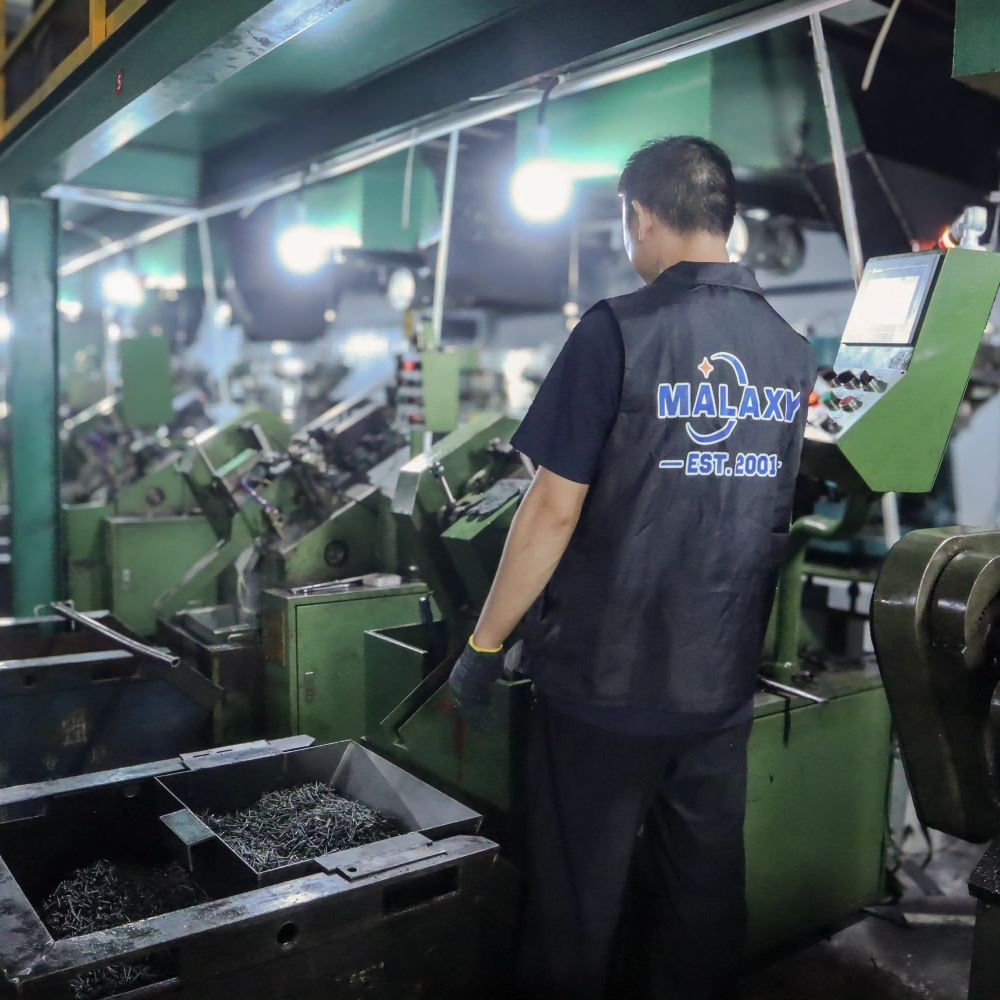
Inside MALAXY’s Fastener Factory in Haiyan, Zhejiang
10 Important Factors to Consider When Buying Industrial Fasteners: A Complete Guide for Global Buyers
