


Product Category


Set Screws / Grub Screws – Headless Threaded Fasteners for Shaft Locking & Component Positioning
MALAXY supplies set screws (also known as grub screws) manufactured to DIN 913/914/915/916, ISO 4026/4027/4028/4029, and ANSI/ASME B18.3 standards. Features headless design with hex socket drive for flush installation. Available in five point styles: flat, cone, cup, dog, and half-dog. Materials include alloy steel (grade 12.9 / 45H), stainless steel (304, 316, 410), and carbon steel. Surface finishes: black oxide, zinc plating, Dacromet, and passivated. Widely used in shaft collars, gearboxes, pulleys, sprockets, motors, and precision machinery. Custom sizes and OEM supported.

Product Overview
MALAXY, a leading fastener manufacturer headquartered in Shanghai, supplies premium set screws (also known as grub screws) — headless threaded fasteners designed to be fully recessed into a tapped hole, securing one component against another without any protruding head. Unlike traditional bolts that require a nut, set screws function by exerting axial force directly through the point of the screw onto a mating surface, creating a mechanical lock that prevents relative movement.
The headless design allows set screws to be driven flush with or below the workpiece surface, making them indispensable in applications where clearance is limited, aesthetics matter, or a protruding head would interfere with moving parts. These fasteners are fully threaded and driven using an internal hex socket (Allen key), providing clean, unobtrusive fastening with high torque transfer capability.
Set screws are fundamental to mechanical power transmission systems, precision machinery, and industrial equipment. They are most commonly used to lock gears, pulleys, sprockets, collars, bearings, and couplings onto rotating shafts, preventing axial or rotational movement.
Point Styles — Five Configurations for Different Holding Requirements
The point style of a set screw determines how it engages with the mating surface, directly affecting holding power, shaft damage, and suitability for different materials. MALAXY offers five standard point styles to meet diverse application needs.
Point Style | DIN Standard | ISO Standard | Characteristics | Best Applications |
|---|---|---|---|---|
Cup Point (凹端) | DIN 916 | ISO 4029 | Cup-shaped indentation creates a circular cutting edge that bites into the mating surface; highest holding power among all point styles | Most versatile and widely used; permanent/semi-permanent installations on shafts, pulleys, gears; ideal for steel and hard materials |
Cone Point (锥端) | DIN 914 | ISO 4027 | Sharp 90° cone tip wedges into the contact material, providing precise centering and strong bite with minimal contact area | Permanent positioning on soft shafts (aluminum, brass, plastic); fine adjustment applications; where maximum penetration is required |
Dog Point (柱端) | DIN 915 | ISO 4028 | Extended cylindrical pilot tip fits into a drilled hole or keyway on the shaft; guides alignment and prevents lateral movement | Alignment-critical assemblies; shafts with pre-drilled locating holes; preventing axial movement with guided fit |
Half-Dog Point (半柱端) | DIN 553 | — | Shorter pilot tip than full dog point, fits into shallow recesses | Positioning with limited pilot hole depth; light-duty alignment applications |
Flat Point (平端) | DIN 913 | ISO 4026 | Flat, non-marring end provides uniform surface contact without digging into the shaft | Soft or delicate materials (plastic, brass, soft metals); applications requiring frequent repositioning; where shaft surface must remain undamaged |
Selection Guide:
Cup Point — Most common general-purpose choice; best holding power for steel shafts.
Cone Point — For permanent fixation into softer materials; excellent centering.
Dog Point — For precise alignment when shaft has pre-drilled locating holes.
Flat Point — For soft shafts where surface damage must be avoided.
Knurled Cup Point — Serrated cup point for enhanced vibration resistance in high-vibration environments.
Standards & Compliance
MALAXY set screws are manufactured in strict compliance with major international standards, ensuring global compatibility and interchangeability.
Metric Standards
Standard | Point Style | Thread Size Range | Applicable Markets |
|---|---|---|---|
DIN 913 | Flat point | M1.6 – M24 | Europe, Global |
DIN 914 | Cone point | M1.6 – M24 | Europe, Global |
DIN 915 | Dog point | M1.6 – M24 | Europe, Global |
DIN 916 | Cup point | M1.4 – M24 | Europe, Global (most widely used) |
ISO 4026 | Flat point | M1.6 – M24 | International (equivalent to DIN 913) |
ISO 4027 | Cone point | M1.6 – M24 | International (equivalent to DIN 914) |
ISO 4028 | Dog point | M1.6 – M24 | International (equivalent to DIN 915) |
ISO 4029 | Cup point | M1.6 – M24 | International (equivalent to DIN 916) |
DIN 916 has been replaced by ISO 4029. Both remain in active use and are interchangeable. The standard covers nominal diameters from M1.4 to M24, with key dimensions including thread size, pitch, hex socket width, cup point diameter, and length classifications.
Inch Standards
Standard | Point Styles | Thread Size Range | Applicable Markets |
|---|---|---|---|
ANSI/ASME B18.3 | Cup / Cone / Flat / Dog / Half-dog | #0 – 1″ | USA, North America |
ASTM F880 | Cup / Cone / Flat / Dog | #0 – 1″ | USA (stainless steel specification) |
ANSI/ASME B18.3 covers complete general and dimensional data for hexagon socket set screws in inch series, including cup point, cone point, flat point, dog point, and half-dog point configurations. ASTM F880 specifies requirements for stainless steel socket set screws under grades 303, 304, 304L, 316, and 316L.
All products undergo rigorous quality control including dimensional verification, thread gauge inspection, hardness testing, and mechanical performance validation. MALAXY maintains ISO 9001:2015 quality management certification throughout the manufacturing process.
Material Grades & Mechanical Properties
Material | Grade / Class | Tensile Strength | Hardness | Corrosion Resistance | Best Applications |
|---|---|---|---|---|---|
Carbon Steel | Grade 45H (case-hardened) | 800–1,000 MPa | 45–52 HRC | Low (requires coating) | General industrial, cost-effective applications |
Alloy Steel | Grade 12.9 | 1,220–1,760 MPa | 39–44 HRC | Low (requires coating) | Heavy-duty machinery, automotive, high-stress mechanical systems |
Stainless Steel 304 (A2 / 18-8) | A2-70 | 500–700 MPa | 20–30 HRC | High | General outdoor use, food equipment, mild corrosion environments |
Stainless Steel 316 (A4) | A4-80 | 600–800 MPa | 20–30 HRC | Superior (marine grade) | Marine, offshore, coastal construction, chemical processing |
Stainless Steel 410 | — | 500–700 MPa | 35–45 HRC | Moderate | Heat-treated for enhanced point hardness; excellent for cutting into shafts |
Brass | — | 200–400 MPa | — | Good | Electrical conductivity, low-load applications, decorative |
Titanium (Grade 5) | — | 900–1,100 MPa | — | Excellent | Aerospace, medical devices, high-performance applications |
Selection Guide:
Alloy steel 12.9 — Highest strength; for heavy loads and high-stress applications.
Stainless steel 304 — Best balance of corrosion resistance and cost for general outdoor use.
Stainless steel 316 — Maximum corrosion protection for marine, coastal, and harsh environments.
Stainless steel 410 — Heat-treated for maximum hardness; ideal for cutting into shafts.
Carbon steel 45H — Cost-effective for indoor industrial use with protective coating.
ISO 3506-3 standard specifies mechanical and physical properties of set screws made of corrosion-resistant stainless steels.
Surface Finishes
Finish | Corrosion Resistance | Appearance | Typical Applications |
|---|---|---|---|
Black Oxide | Low (enhanced with oil/wax) | Matte black | Most common for set screws; minimal dimensional change; requires oil coating for rust protection |
Zinc Plated (Yellow/Clear) | Moderate (24–72 hrs salt spray) | Bright, shiny | General industrial, cost-effective corrosion protection |
Zinc Plated (Blue/Black) | Moderate (24–72 hrs salt spray) | Blue or black tint | Automotive interior, visible applications |
Dacromet / Geomet | High (500+ hrs salt spray) | Silver-grey | Heavy industrial, automotive underbody, high-corrosion environments |
Passivated | Enhanced (stainless steel only) | Bright, clean | Removes free iron from stainless steel surface; medical, marine, food processing |
Nickel Plated | Moderate-High | Bright, silver | Electrical conductivity, decorative applications, wear resistance |
Hydrogen Embrittlement Warning: For high-strength set screws (grade 12.9) with electroplated coatings, baking per ASTM standards is recommended to prevent hydrogen embrittlement.
Drive Type
MALAXY set screws feature hex socket drive (internal hexagonal recess), driven using standard Allen keys (hex wrenches). Hex socket drive provides excellent torque transfer, allows flush installation, and is the industry standard for headless set screws. Unlike external hex drives, the hex socket does not require protruding head clearance.
Metric Hex Wrench Reference: M2→0.9mm, M3→1.5mm, M4→2.0mm, M5→2.5mm, M6→3.0mm, M8→4.0mm, M10→5.0mm.
Inch Hex Wrench Reference: #6-32→1/16″, #8-32→5/64″, #10-32→3/32″, 1/4″-20→1/8″.
Applications
Set screws are fundamental components in mechanical power transmission, precision machinery, and industrial equipment across virtually every sector.
1. Shaft Collars & Locking Collars
Single largest application. Set screws secure shaft collars onto rotating shafts, limiting axial movement and positioning power transmission components such as gears, sprockets, pulleys, and bearings. The set screw bites into the shaft, creating a mechanical lock that prevents slippage under torque.
2. Gearboxes & Power Transmission
Securing gears and sprockets onto drive shafts. Set screws prevent rotational slip and axial movement under load, essential for reliable power transmission in industrial machinery, conveyors, and heavy equipment.
3. Pulleys & Belt Drives
Locking pulleys onto motor shafts and driven shafts in belt drive systems. Cup point set screws provide the holding power needed to withstand belt tension and torque fluctuations.
4. Industrial Machinery & Precision Equipment
Positioning and locking components in CNC machines, robotics, automation equipment, printing presses, packaging machinery, and precision instruments. Headless design allows flush installation in space-constrained assemblies.
5. Motors & Actuators
Securing couplings, fans, rotors, and position sensors onto motor shafts. Cone point set screws provide precise centering for balanced rotation.
6. Automotive & Heavy Equipment
Securing components in engines, transmissions, steering systems, braking systems, and chassis assemblies. Alloy steel grade 12.9 set screws are specified for high-stress applications.
7. Aerospace & Defense
Critical applications requiring high strength, corrosion resistance, and precise positioning. Stainless steel and titanium grades specified for aircraft interiors, avionics, and defense equipment.
8. Marine & Offshore
Stainless steel 316 set screws with passivated finish provide exceptional resistance to saltwater corrosion. Used in deck hardware, navigation equipment, pumps, and offshore platform components.
9. Medical Equipment
Stainless steel set screws used in surgical instruments, diagnostic devices, hospital furniture, and laboratory equipment. Biocompatible grades specified for implant-adjacent applications.
10. Mold & Die Tooling
Positioning and locking components in injection molds, stamping dies, and fixture tooling. Flat point set screws prevent marring of precision-ground surfaces while maintaining secure clamping.
Key Features
Headless Design – Fully threaded with no protruding head; can be driven flush with or recessed below the workpiece surface for unobtrusive fastening.
Hex Socket Drive – Internal hexagonal recess driven with standard Allen keys; provides high torque transfer and allows installation in confined spaces.
Five Point Styles – Cup, cone, dog, half-dog, and flat points available to match specific holding, alignment, and surface protection requirements.
Fully Threaded – Continuous threads along entire length for maximum thread engagement and consistent clamping force.
Versatile Material Options – Alloy steel grade 12.9 (highest strength), carbon steel grade 45H (cost-effective), stainless steel 304/316 (corrosion-resistant), stainless steel 410 (heat-treated hardness), brass (conductivity), and titanium (lightweight high-strength).
Multiple Surface Finishes – Black oxide (most common), zinc plating, Dacromet/Geomet, nickel plating, and passivated for stainless steel.
Global Standard Compliance – Manufactured to DIN 913/914/915/916, ISO 4026/4027/4028/4029, and ANSI/ASME B18.3, ensuring global acceptance and interchangeability.
Metric & Inch Sizes – Metric range M1.6–M24; inch range #0–1″; both coarse and fine thread pitches available.
Corrosion-Resistant Options – Stainless steel 316 set screws with passivated finish for marine, offshore, and harsh environments.
Custom Manufacturing – Non-standard lengths, special materials, custom point configurations, and OEM packaging available upon request.
Customization & OEM Services
As a leading fastener manufacturer with decades of industry expertise and a strategic headquarters in Shanghai, MALAXY offers comprehensive customization and OEM services for set screws:
Non-standard lengths and diameters beyond standard ranges
Custom point style configurations for specialized applications
Special material grades (Inconel, Monel, titanium, custom alloy compositions)
Proprietary surface treatments and coating systems
Left-hand threads for specialized assemblies
Custom hex socket dimensions
Logo marking and custom packaging solutions
SEMS pre-assembly with custom components
Our in-house engineering team supports OEM and ODM projects from prototype to mass production, with strict adherence to ISO 9001:2015 quality management systems. MALAXY maintains full traceability from raw material sourcing to finished product, providing mill test reports (MTRs), dimensional inspection reports, hardness test reports, third-party lab testing, and certification upon request. Short lead times and competitive pricing through direct manufacturing with no middlemen.
Why Choose MALAXY?
Headquarters in Shanghai – Strategic location with efficient global logistics, direct port access, and strong English-speaking export support teams.
Industry-leading reputation – Recognized as a top-tier fastener supplier across Asia, Europe, North America, the Middle East, and Latin America.
Comprehensive quality control – Full inspection from raw material to finished product, including dimensional verification, thread gauge inspection, hardness testing, case depth measurement, and mechanical performance validation per applicable standards.
Global standard compliance – Full certification to DIN 913/914/915/916, ISO 4026/4027/4028/4029, ANSI/ASME B18.3, and ASTM F880; ISO 9001:2015 certified; RoHS/REACH compliance for regulated markets.
Competitive pricing – Direct manufacturing with integrated production lines, no middlemen, offering cost-effective solutions for both standard and custom requirements.
Global export experience – Serving clients across North America, Europe, Southeast Asia, the Middle East, Latin America, and Africa with proven track record in B2B industrial fastener supply.
Technical support – In-house engineering team available for application consultation, point style selection guidance, torque specification, material selection, and custom design development.
Contact MALAXY today for quotes, technical specifications, custom manufacturing inquiries, sample requests, or engineering consultation.
Related News
-
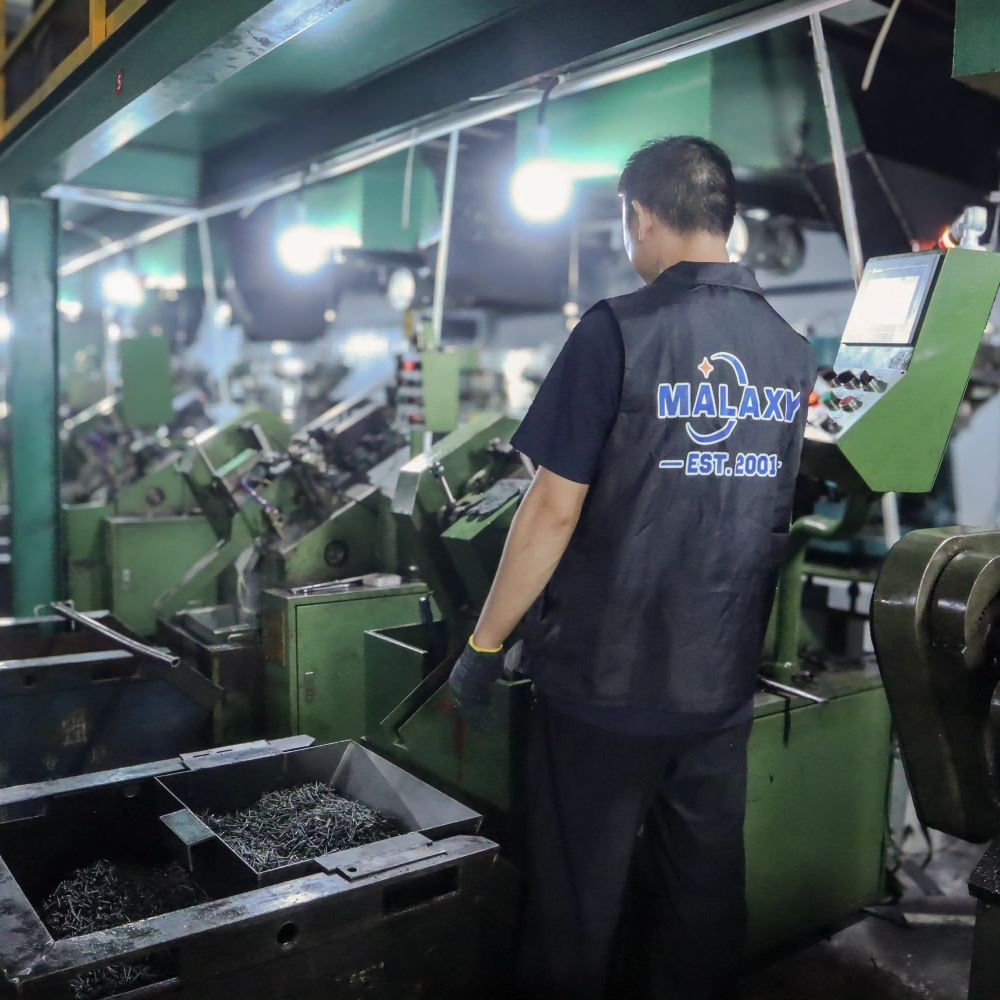 MALAXY is a China-based fastener manufacturer with over 20 years of factory experience in Haiyan, Zhejiang. With a 50,000 m² factory, 200+ employees and exports to 70+ countries, MALAXY supplies self-tapping screws, self-drilling screws, wood screws, hex nuts and other fasteners to global manufacturers, wholesalers and construction contractors. Supported by CE, RoHS, REACH and ISO 9001:2015 certifications, MALAXY provides reliable quality, competitive factory-direct pricing and customized fastener and packaging solutions for bulk B2B buyers.Malaxy Company News
 -
 Learn 10 essential factors when buying industrial fasteners, including materials, corrosion protection, standards, quality control, and supplier selection tips.Fastener Technology News
 -
 Learn the main types of fasteners and how to choose bolts, screws, nuts, anchors, and washers by material, strength, coating, standards, and application needs.Fastener Technology News
