


Thread Rolling vs. Thread Cutting: What Are the Differences?
Industry News | November 12, 2026
Thread manufacturing is a critical process in the production of industrial fasteners. Although thread rolling and thread cutting create similar thread profiles, they differ significantly in manufacturing methods, mechanical properties, production efficiency and cost.
For bolt, screw and threaded rod buyers, understanding these differences helps identify the right manufacturing process for specific applications.
This article compares both technologies and explains how manufacturers and industrial buyers should evaluate them.
1. What Is Thread Rolling?
Thread rolling is a cold-forming process that produces external threads by pressing a metal blank between hardened steel dies.
Unlike machining, it does not remove material. Instead, pressure causes the metal to flow into the required thread profile.
How Thread Rolling Works:
Prepare the steel wire or metal blank.
Cut the blank to the required length.
Position the workpiece between rolling dies.
Apply pressure to form the thread profile.
Inspect thread dimensions and surface quality.
Complete subsequent heat treatment or surface finishing according to product specifications.
Main Advantages:
No metal chips during thread formation.
Improved material utilization.
Continuous grain flow around the thread profile.
Potentially improved fatigue resistance.
High production efficiency for mass-produced fasteners.
Expert Insight (Manufacturer Experience): Thread rolling is widely used for mass-produced bolts and screws. However, blank diameter, material hardness and die condition must be carefully controlled to ensure consistent thread dimensions.

2. What Is Thread Cutting?
Thread cutting is a machining process that creates threads by removing material from a metal workpiece.
Cutting tools gradually remove material to produce the required thread pitch, depth and profile.
Common Thread Cutting Methods:
Method | Process | Application |
|---|---|---|
Thread Turning | Single-point cutting tool | Bolts and shafts |
Thread Milling | Rotating cutting tool | Precision components |
Tapping | Cutting internal threads | Nuts and threaded holes |
Main Advantages:
Flexible for customized thread profiles.
Suitable for small production batches.
Can produce special pitches and geometries.
Useful for materials that are difficult to cold-form.
Expert Insight (Manufacturer Experience): Thread cutting is particularly useful for prototypes, customized components and special thread specifications. However, machining time, cutting-tool wear and material waste should be considered when evaluating production costs.

3. Thread Rolling vs. Thread Cutting: Key Differences
The fundamental difference is how each process changes the metal.
Thread rolling forms threads through plastic deformation, while thread cutting removes material to create the thread profile.
Comparison | Thread Rolling | Thread Cutting |
|---|---|---|
Process | Cold forming | Material removal |
Metal chips | No | Yes |
Grain structure | Generally follows thread profile | Interrupted by machining |
Work hardening | Yes | Limited |
Fatigue resistance | Generally favorable | Depends on machining and material |
Production speed | High for mass production | Generally lower |
Initial tooling cost | Higher | Generally lower |
Best application | Standard high-volume fasteners | Custom and low-volume parts |
Are Rolled Threads Stronger Than Cut Threads?
Rolled threads can provide better fatigue resistance because the forming process maintains material continuity and can generate compressive residual stresses near the thread root.
However, actual performance depends on steel grade, heat treatment, thread geometry and manufacturing quality.
Performance Factor | Rolling | Cutting |
|---|---|---|
Grain flow | Favorable continuity | Interrupted |
Surface condition | Generally smoother | Tool-dependent |
Fatigue performance | Often better under suitable conditions | More dependent on machining conditions |
Expert Insight (Manufacturer Experience): For high-volume bolts and screws exposed to repeated loading or vibration, thread rolling is often preferred. Nevertheless, buyers should evaluate actual mechanical test results rather than assume every rolled fastener automatically outperforms every cut-thread product.
4. Which Materials and Applications Are Suitable?
Material properties directly affect thread manufacturing results. Ductility, hardness and chemical composition determine whether a material can withstand cold forming.
Material | Thread Rolling | Thread Cutting |
|---|---|---|
Low-carbon steel | Highly suitable | Suitable |
Medium-carbon steel | Suitable with process control | Suitable |
Alloy steel | Grade-dependent | Suitable |
Stainless steel 304 | Suitable with proper control | Suitable |
Stainless steel 316 | Suitable with proper control | Suitable |
Brass | Suitable for appropriate alloys | Suitable |
Common Fastener Applications
Bolts: Thread rolling is widely used for standard industrial and construction bolts.
Wood Screws: Rolling supports efficient production of external threads.
Self-Tapping Screws: Rolling is commonly used for forming screw threads.
Threaded Rods: Thread rolling is suitable for high-volume standardized production.
Custom Fasteners: Thread cutting offers greater flexibility for special designs.
Relevant standards include ISO 898-1 for mechanical properties of carbon and alloy steel fasteners, ISO 965 for metric thread tolerances and ISO 1502 for thread gauging.
Expert Insight (Manufacturer Experience): For high-strength fasteners such as grades 8.8, 10.9 and 12.9, manufacturers must carefully control thread geometry, heat treatment and surface defects. The correct process depends on the complete product specification.
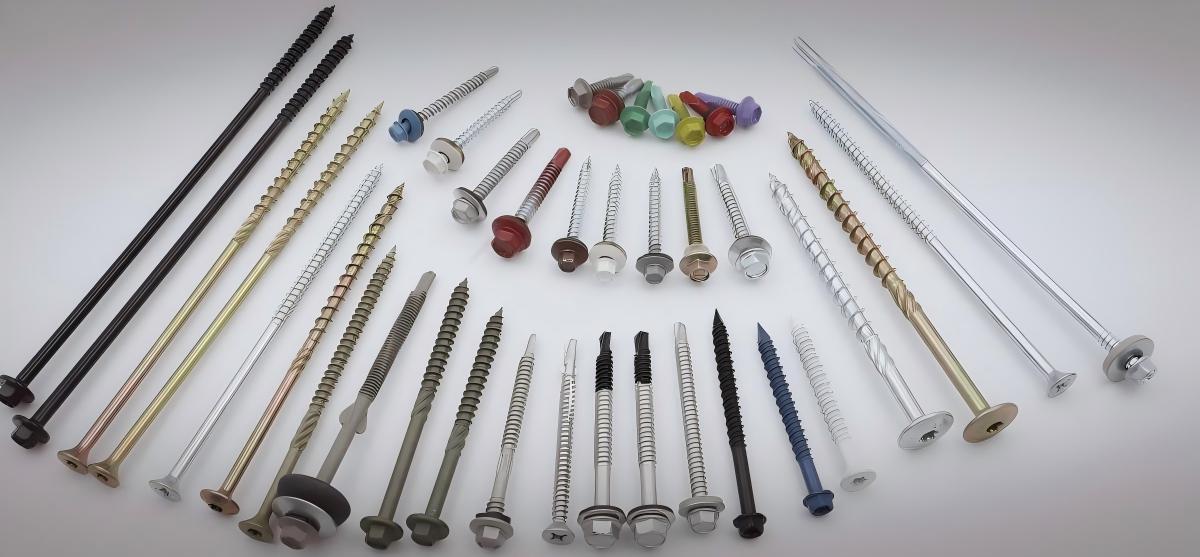
5. 2026 Fastener Manufacturing Trends and Buyer Recommendations
The fastener manufacturing industry continues to focus on production efficiency, material utilization, quality consistency and supply chain reliability.
According to the World Steel Association's October 2026 Short Range Outlook, global steel demand is forecast to reach 1,722 million tonnes in 2026 and 1,752 million tonnes in 2027, representing projected growth of 1.7% in 2027.
The OECD's June 2026 Steel Outlook also highlights growing global excess steelmaking capacity, projected to reach 745 million tonnes by 2028.
These developments reinforce the importance of production efficiency and raw material cost management for manufacturers.
Three Important Trends:
Manufacturing Automation: Automatic feeding, precision rolling dies and integrated inspection systems improve production consistency.
Material Efficiency: Thread rolling reduces material waste during thread formation because it does not generate machining chips.
Quality Traceability: International buyers increasingly evaluate material certificates, inspection records and batch consistency.
How Should Buyers Choose?
Buyer Requirement | Recommended Process |
|---|---|
Large-volume standard bolts | Thread Rolling |
Mass-produced screws | Thread Rolling |
High fatigue-performance requirements | Thread Rolling, subject to testing |
Small custom orders | Thread Cutting |
Special thread geometries | Thread Cutting |
Expert Insight (Manufacturer Experience): A reliable fastener supplier should evaluate material, thread dimensions, production quantity and mechanical requirements before selecting the manufacturing process. Consistent quality is more important than simply choosing the fastest production method.

Conclusion
Thread rolling and thread cutting are both important technologies in fastener manufacturing.
Thread rolling is generally preferred for high-volume production because of its material efficiency, production speed and potential fatigue-performance advantages.
Thread cutting offers greater flexibility for customized products, special thread geometries and smaller production quantities.
For international buyers, the best choice depends on material specifications, mechanical performance, application requirements and manufacturing quality.
With over 20 years of manufacturing experience, a 50,000 m² production facility and OEM/ODM capabilities, MALAXY provides fastener solutions for international industrial buyers.
1. What is the difference between rolled threads and cut threads?
Rolled threads are formed by pressing metal between dies, while cut threads are produced by removing material with cutting tools. Rolling generally provides better material continuity and fatigue performance, while cutting offers greater manufacturing flexibility.
2. Are rolled threads stronger than cut threads?
Rolled threads generally have better fatigue resistance because of grain flow, work hardening and compressive residual stresses. However, actual performance depends on material properties, heat treatment and manufacturing quality.
3. Is thread rolling suitable for stainless steel?
Yes. Stainless steel 304 and 316 can be thread rolled with appropriate blank dimensions, forming pressure and lubrication. Work hardening and galling must be controlled.
4. Which process is more cost-effective?
Thread rolling is generally more economical for large production quantities. Thread cutting can be more cost-effective for small batches, prototypes and customized thread designs.
5. Can high-strength bolts use rolled threads?
Yes. Rolled threads are commonly used for high-strength fasteners. Manufacturers must control material hardness, thread geometry, heat treatment and surface quality.
6. How can buyers check thread quality?
Buyers can request thread inspection using GO/NO-GO gauges, pitch diameter measurement and visual inspection. Mechanical testing and material certificates should also be requested when required by the product specification.
Other Articles

EV Growth Is Reshaping Engineered Fastener Demand

Plastic Screw Installation Torque: Prevent Stripping, Cracking & Pull-Out
