


Beyond the Salt Spray: What Really Makes a Fastener Last?
Fasteners – bolts, nuts, screws, washers – are the silent heroes of every structure and machine. But when they fail, the consequences are anything but silent. Rusted or corroded fasteners don’t just look bad; they create safety hazards and lead to expensive repairs, production downtime, or even equipment replacement.
So how do you know if a fastener is truly built to last – especially in harsh environments like marine, chemical, or outdoor applications? This is where salt spray testing comes in. But as with many technical standards, understanding what the test really means (and what it doesn’t) is the key to making the right choice.
What is Salt Spray Testing? A Quick Look Under the Hood
Salt spray testing (also known as salt fog testing) is an accelerated corrosion test. In a closed chamber, a fine saline mist is sprayed onto coated or uncoated metal samples. The goal? To simulate years of real-world exposure in days or weeks instead of waiting for natural rust to form.
For decades, this test has been the industry’s go-to method for comparing corrosion resistance because it’s fast, repeatable, and relatively low-cost. The current international standard, ISO 9227:2012, sets the rules for neutral salt spray testing, with results often expressed as “ratings” based on appearance and oxide formation.
The Truth the Test Doesn’t Tell You
Here’s something many buyers overlook: there is only a weak correlation between a fastener’s hours in a salt spray chamber and its actual service life in the field.
Why? Corrosion is complex. Real-world factors like temperature fluctuations, humidity cycles, mechanical stress, chemical exposure, and even galvanic interaction with different metals all influence how and when rust appears. A fastener that survives 1,000 hours in a lab chamber might fail sooner outdoors – or, conversely, a 500-hour-rated part may perform perfectly for decades in the right environment.
That’s why experienced engineers and quality specialists use salt spray testing not as a final answer, but as a comparative tool – to verify production consistency, compare coating batches, and pass/fail samples against defined requirements. It is most valuable inside a robust quality management system, not as a standalone promise.
From Test Chambers to Real-World Reliability
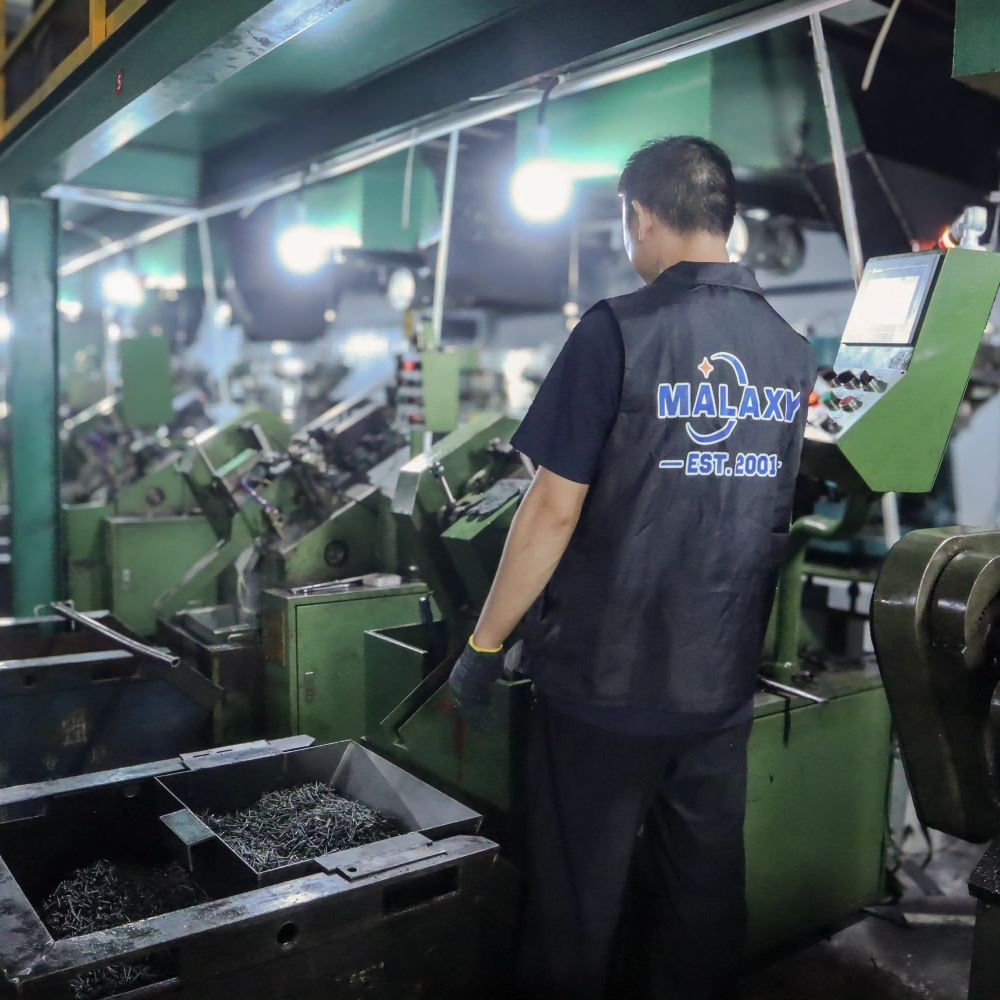
At MALAXY, we’ve been manufacturing fasteners and mechanical components since 2001. Our journey began with Zhejiang Malaxy Hardware Factory, and in 2006 we established our export branch – Shanghai Malaxy Industry Co., Ltd. – to serve partners worldwide.
We don’t just “run salt spray tests.” We integrate corrosion science into every stage of production:
Material selection: High-quality raw materials matched to your environment (carbon steel, alloy steel, stainless steel, and various coatings).
Coating processes: From zinc plating and hot-dip galvanizing to premium topcoats and sealers – we tailor the solution to your required protection level.
In-process controls: ISO 9001, ISO 14001, and IATF 16949 (TS 16949) certified systems ensure every batch is traceable and consistent.
Realistic test plans: Depending on the coating, we conduct 24-hour to 1,000+ hour cycles – not just for a certificate, but to validate production stability.
Why Our Customers Trust MALAXY
We’ve exported fasteners, jacks, and mechanical equipment to over 70 countries – including demanding markets like the USA, Germany, and Peru. Global customers return to us because:
We know the limits of lab tests. We never oversell salt spray hours without explaining real-world performance.
We offer a complete product structure. Bolts, nuts, screws, washers, jacks – you get integrated supply from one reliable source.
We innovate in business and technology. Listening to partner feedback has helped us refine coatings, packaging, and logistics for specific regional conditions (e.g., high humidity coastal areas vs. dry inland environments).
We are building a world-class manufacturer. From our first factory in Zhejiang to our export team in Shanghai, every fastener carries the same commitment to durability and safety.
Practical Tips for Your Fastener Sourcing
Don’t chase the highest hour number. Instead, ask your supplier: “What standard (ISO 9227) do you use? How do you interpret the results? Can you share pass/fail criteria?”
Match the test to the application. A 72-hour salt spray result may be fine for indoor furniture, but offshore equipment may need 500+ hours with additional sealers.
Look beyond the test. Real quality comes from documented systems, material traceability, and a supplier who understands corrosion as a real-world challenge – not just a lab exercise.
Conclusion: Built for What’s Ahead
Fasteners don’t fail because of a single bad test result. They fail when quality, process control, and environmental understanding are missing. For over 20 years, MALAXY has combined rigorous manufacturing standards with practical engineering knowledge – so when you specify a MALAXY bolt, nut, or screw, you’re not buying a “test number.” You’re buying confidence that it will hold, year after year, wherever it’s installed.
Let’s build something that lasts. Contact MALAXY today – because the right fastener is more than a part; it’s a promise.
Other Articles
Inside MALAXY’s Fastener Factory in Haiyan, Zhejiang
10 Important Factors to Consider When Buying Industrial Fasteners: A Complete Guide for Global Buyers
